Blog
Islamic Managed Forex Accounts
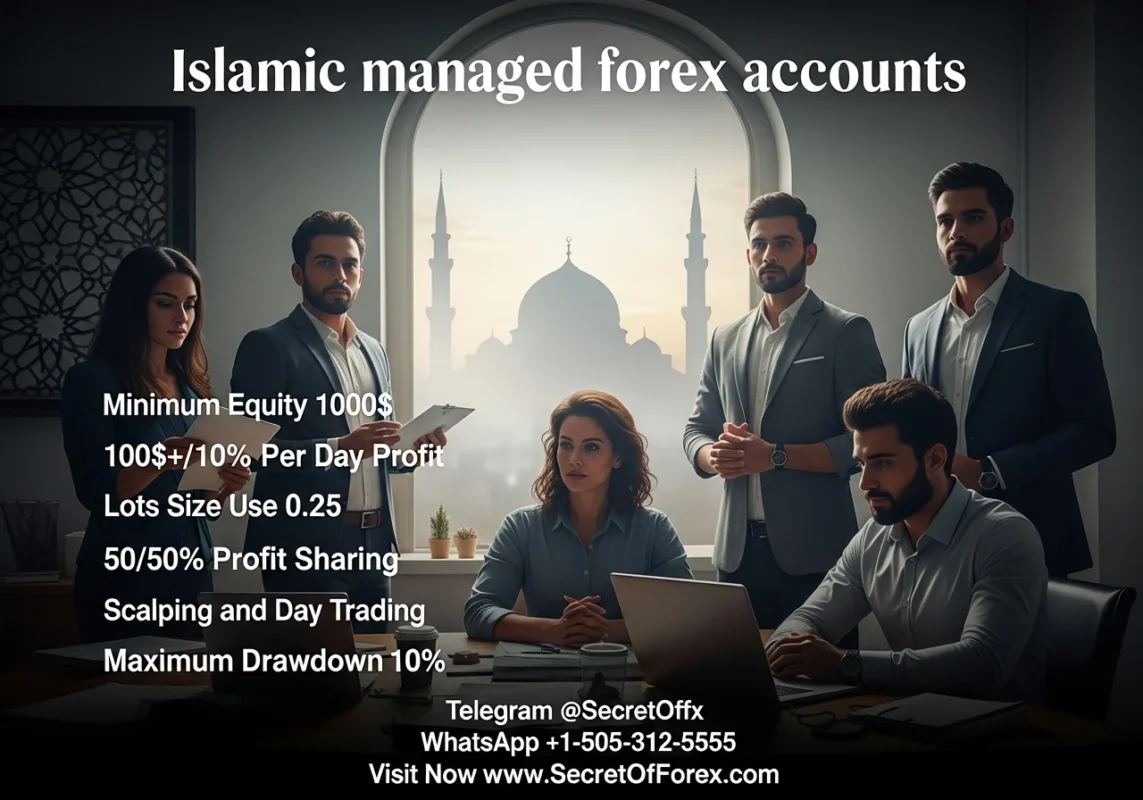
The global foreign exchange (forex) market operates 24 hours a day, facilitating trillions of dollars in currency trades daily. For devout Muslim investors, participating in this massive financial ecosystem presents unique ethical and religious challenges. Traditional forex trading inherently involves interest mechanisms, overnight fees, and speculative elements that directly conflict with Islamic jurisprudence (Sharia).
To bridge this gap, Islamic finance has evolved to offer specialized vehicles: Islamic Managed Forex Accounts (often referred to as Swap-Free Managed Accounts). These accounts allow Muslim investors to delegate capital management to professional traders while ensuring every transaction strictly adheres to Islamic economic principles.
Understanding how these accounts function, their underlying legal structures, and the rigorous criteria required to keep them truly halal is essential for any investor seeking ethical wealth growth.
Contact Us | |
Telegram | |
Mail Us | |
Want to Join All Indicators VIP Access | |
Account Management More Details |

The Core Conflict: Traditional Forex vs. Sharia Law
To understand why a specialized managed account is necessary, one must first grasp why conventional forex trading is problematic under Islamic law. Traditional financial systems rely heavily on time-value-of-money concepts that contradict core Islamic tenets:
- Riba (Usury/Interest): In conventional forex, positions held open past the market close (typically 5:00 PM EST) incur or earn a “swap” or “rollover” fee. This fee is calculated based on the interest rate differentials between the two currencies in the traded pair. Because charging or receiving interest is strictly forbidden (Haram) in Islam, these rollover fees make standard accounts unusable for observant Muslims.
- Gharar (Excessive Uncertainty/Ambiguity): Sharia demands absolute transparency in commercial contracts. Transactions where the outcome is highly ambiguous, or where crucial information is hidden, are prohibited. Standard retail forex, often characterized by extreme leverage and opaque execution, frequently crosses into the territory of Gharar.
- Maysir (Gambling/Speculation): While taking calculated business risks is encouraged in Islam, pure speculation or gambling on price movements without underlying economic substance is forbidden. Short-term day trading that resembles a roll of the dice violates the spirit of Islamic commerce.
The Architecture of an Islamic Managed Forex Account
An Islamic Managed Forex Account resolves these conflicts through a modified operational and legal framework. It combines professional portfolio management with Sharia-compliant transactional mechanics.
1. The Swap-Free Mechanism
The defining feature of an Islamic account is the total elimination of swap or rollover fees. When a managed account provider holds a currency position overnight, the broker does not charge an interest-based fee, nor does it credit the account with interest.
To offset the operational costs of holding these positions, brokers usually adjust their compensation structures. This is typically done by widening the spread (the difference between the buy and sell price) or charging a flat, upfront commission per trade. Islamic scholars deem this acceptable as long as the fee is a fixed charge for a service rendered, rather than a variable rate tied to the passage of time or interest rates.
2. The Power of Attorney (POA) and LPOA Framework
Because these are managed accounts, the investor does not execute trades. Instead, they sign a Limited Power of Attorney (LPOA) agreement. This legal document grants a professional Money Manager or Commodity Trading Advisor (CTA) the authority to trade the account’s capital on the investor’s behalf.
Crucially, an LPOA only grants trading rights; the manager cannot withdraw funds or transfer capital out of the account. The investor retains full ownership and control over deposits and withdrawals.
3. Permissible Financial Contracts
To ensure the relationship between the investor, the manager, and the broker is halal, the underlying business structures rely on recognized Islamic contract models:
| Contract Type | Mechanics in Forex Management |
| Mudarabah (Profit-Sharing Partnership) | The investor provides the capital (Rab-al-Maal), and the manager provides the expertise (Mudarib). Profits are split according to a mutually agreed-upon percentage. If a loss occurs, the investor bears the financial loss, while the manager loses their time and effort—provided the loss wasn’t due to the manager’s negligence or misconduct. |
| Wakala (Agency Contract) | The investor appoints the manager as an agent (Wakil) to manage the funds in exchange for a predetermined, fixed fee or a performance-based incentive. This structure provides high predictability regarding operational costs. |
Critical Criteria for True Sharia Compliance
Not all accounts labeled “Islamic” or “Swap-Free” are genuinely Sharia-compliant. True compliance requires looking beyond marketing terms to verify the structural integrity of the offering.
Hand-to-Hand Exchange (Taqabudh)
In traditional Islamic law, currency exchange (Sarf) must take place on a spot basis—meaning the exchange must be immediate or “hand-to-hand.” In modern electronic trading, physical delivery of currency rarely occurs.
To satisfy this requirement, Islamic financial scholars accept the concept of constructive possession. This means that as soon as a trade is executed, the transaction must be credited to the investor’s account instantly, creating an immediate legal obligation and ownership right, even if the physical cash remains within the banking system. Forward contracts or futures contracts, which delay settlement to a future date, remain strictly prohibited.
Strict Leverage Restrictions
Leverage allows traders to control large positions with a small amount of capital. In conventional forex, leverage is essentially an interest-free loan from the broker, which is then tied to an interest-bearing rollover fee.
In an Islamic managed account, leverage must be handled with extreme care. Many scholars argue that if a broker provides interest-free leverage but requires the client to trade exclusively through their platform, it violates the Islamic rule against combining a loan with a commercial sale (Qard wa Bay). Therefore, compliant managed accounts often operate with significantly lower leverage ratios to reduce risk and maintain ethical purity, ensuring the relationship does not exploit the borrower.
Independent Sharia Supervision
A reputable Islamic managed account provider will not simply self-certify its compliance. It should be backed by an independent Sharia Board or an external Islamic auditing firm. These bodies, comprised of qualified Islamic scholars specializing in modern finance, review the trading strategies, fee structures, and execution methods. They issue a formal fatwa (legal opinion) verifying that the account operates within acceptable boundaries.
The Benefits of a Managed Approach for Muslim Investors
For individuals who wish to diversify their portfolios into foreign exchange, a managed account offers several distinct advantages over self-directed trading.
                  ┌────────────────────────────────────────┐
                  │       Prospective Muslim Investor      │
                  └───────────────────┬────────────────────┘
                                      │
                         Signs LPOA & Funds Account
                                      ▼
                  ┌────────────────────────────────────────┐
                  │   Islamic Managed Account Portfolio   │
                  └───────────────────┬────────────────────┘
                                      │
                        Executes Swap-Free Trades
                                      ▼
                  ┌────────────────────────────────────────┐
                  │    Professional Sharia-Compliant       │
                  │             Money Manager              │
                  └────────────────────────────────────────┘
- Mitigation of Emotional Trading (Maysir): Unexperienced retail traders often treat the forex market like a casino, letting greed and fear dictate their moves. This emotional volatility closely aligns with the prohibited spirit of Maysir. By handing control to a professional manager who uses disciplined, algorithmic, or deeply researched strategies, the element of reckless gambling is effectively removed.
- Institutional Expertise: Forex markets are heavily influenced by complex macroeconomic data, geopolitical events, and central bank policies. Professional managers possess the analytical tools and institutional experience necessary to navigate these waters safely, protecting investor capital far better than an amateur could.
- Time Efficiency: Properly analyzing currency markets requires constant vigilance. A managed account offers a passive investment vehicle, letting professionals do the heavy lifting while the investor focuses on their career, family, and community.
Risks and Due Diligence: Protecting Your Capital
While Islamic managed forex accounts solve the ethical dilemmas of trading, they do not eliminate financial risk. Currency markets are inherently volatile, and investors must practice due diligence to protect themselves from both market losses and fraudulent operators.
1. Market Volatility and Performance Risks
No manager can guarantee profits. Exchange rates fluctuate based on unpredictable global events. Under a Mudarabah agreement, if the market moves against the manager’s strategy, the investor will experience capital depreciation. Prospective investors should review a manager’s historical drawdown metrics—the maximum observed peak-to-trough drop in portfolio value—to understand the level of risk they are taking.
2. Hidden Fees and “Ghost” Swaps
Because brokers lose revenue by eliminating swap fees, some untrustworthy entities find alternative ways to extract that money. They might quietly widen spreads to exorbitant levels during overnight hours or add hidden administration fees that match the exact value of the omitted swap. Investors should insist on complete transparency regarding the Total Expense Ratio (TER) of the account.
3. Regulatory Verification
Before transferring funds, ensure that the broker holding the capital and the asset manager trading it are regulated by reputable financial watchdogs. Examples include:
- The Financial Conduct Authority (FCA) in the United Kingdom
- The Australian Securities and Investments Commission (ASIC)
- The Dubai Financial Services Authority (DFSA) (which features strong frameworks for Islamic finance)
Warning Sign: Avoid any managed account provider that guarantees fixed monthly returns. Fixed returns on capital strongly imply an interest-based mechanism (Riba) and are fundamentally incompatible with the risk-sharing principles of Islamic finance. Profits must always be variable and based on actual market performance.
Contact Us | |
Telegram | |
Mail Us | |
Want to Join All Indicators VIP Access | |
Account Management More Details |
Conclusion
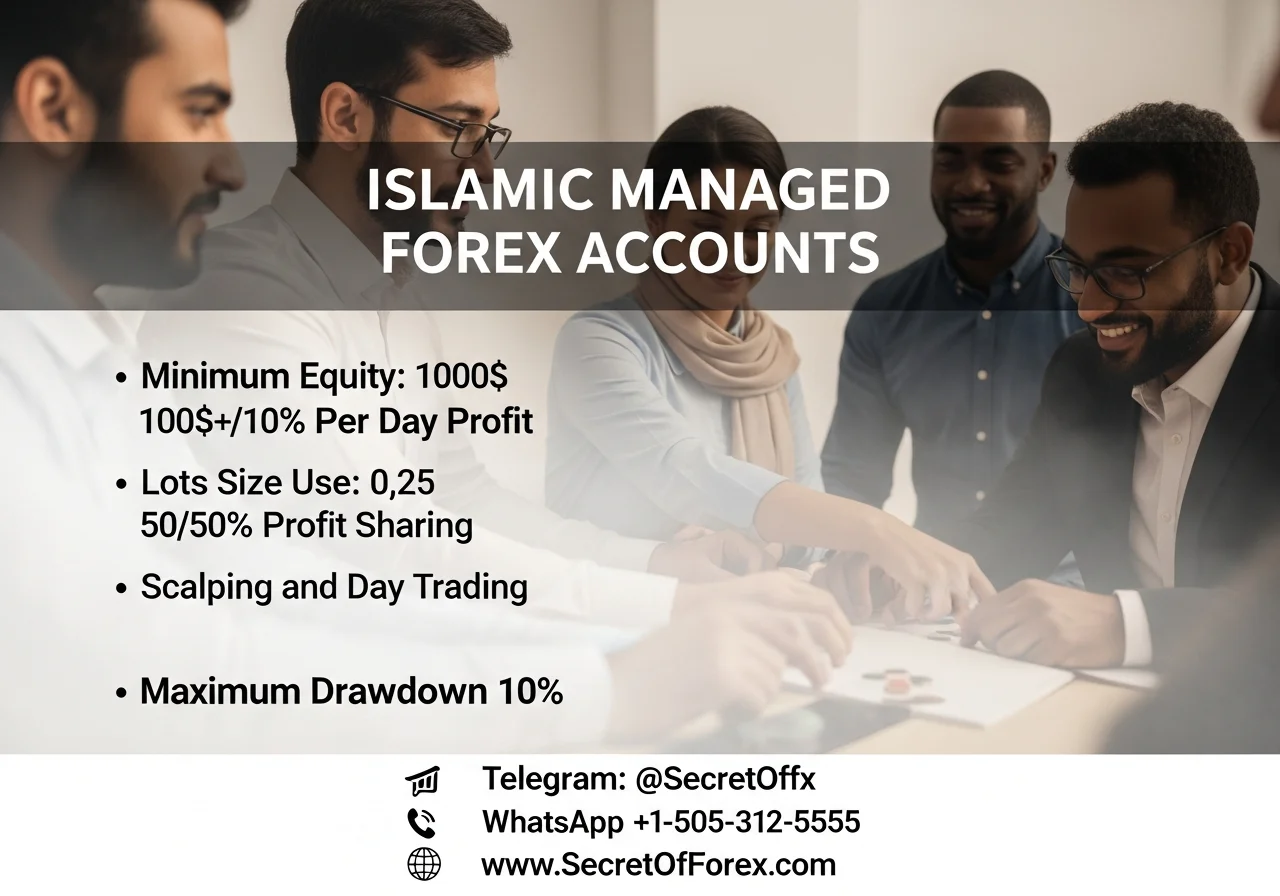
Islamic Managed Forex Accounts offer a sophisticated, modern solution for Muslim investors looking to participate in the global currency markets without compromising their religious values. By removing interest-based swap fees, utilizing ethical profit-sharing contracts like Mudarabah, and operating under the guidance of Sharia scholars, these accounts transform a volatile financial instrument into an ethical investment vehicle.
However, the responsibility of due diligence ultimately rests with the investor. Verifying the independence of the Sharia board, evaluating the regulatory status of the broker, and understanding the fee structures are critical steps. When executed correctly with a transparent, skilled manager, an Islamic managed account serves as a powerful tool for ethical wealth accumulation and global portfolio diversification.