Blog
Low Risk High Return Managed Forex Accounts

The foreign exchange (forex) market is the largest and most liquid financial market in the world, operating 24 hours a day across global financial hubs. For retail and institutional investors alike, its vast liquidity and systemic volatility offer significant profit potential. However, navigating the intricate dynamics of currency fluctuations requires deep technical knowledge, continuous market monitoring, and sophisticated risk management frameworks.
For investors who lack the time or specialized expertise to trade independently, Managed Forex Accounts present a compelling alternative. These financial structures delegate portfolio management to professional currency traders or automated algorithmic systems.
While the allure of “low-risk, high-return” opportunities is frequently used as a marketing narrative in the financial services sector, an objective analysis reveals that risk and return are fundamentally coupled. To achieve sustained success in managed forex investing, one must look past marketing slogans and understand how professional managers mitigate systemic downsides to optimize risk-adjusted returns.
Contact Us | |
Telegram | |
Mail Us | |
Want to Join All Indicators VIP Access | |
Account Management More Details |

1. Understanding Managed Forex Accounts
A managed forex account is an arrangement where an investor deposits capital into a trading account, and a professional money manager or an institutional trading desk executes trades on their behalf. Unlike mutual funds or traditional hedge funds where capital is pooled into a single corporate entity or trust, managed forex structures typically allow investors to retain individual ownership of their accounts.
[ Investor Capital ] ──► [ Individual Brokerage Account ]
                                  │ (Retains Ownership & Capital)
                                  ▼
                     [ Limited Power of Attorney (LPOA) ]
                                  │ (Trading Authority Only)
                                  ▼
                     [ Professional Money Manager ] ──► Executes Trades
The Role of the Limited Power of Attorney (LPOA)
To facilitate this arrangement without compromising security, investors sign a Limited Power of Attorney (LPOA) agreement with their chosen brokerage. The LPOA strictly defines the boundaries of the manager’s authority:
- Trading Authority: It grants the manager the right to open, manage, and close foreign exchange positions using the investor’s capital.
- Asset Protection: Crucially, it does not give the manager the authority to withdraw funds, transfer capital to external accounts, or alter the core configuration of the investor’s account.
This structural separation ensures that while the investor delegates market execution risk to a professional, they retain total control over deposits and withdrawals.
2. Structural Models: PAMM vs. MAMM vs. Copy Trading
Managed forex solutions are executed through specific software frameworks provided by brokerage firms. The choice of architecture fundamentally impacts how trades are allocated, how risk is distributed, and how performance fees are calculated.
Percentage Allocation Management Module (PAMM)
PAMM is one of the most established frameworks in managed currency trading. In a PAMM account, the manager’s personal capital is combined with the capital of multiple independent investors into a single master trading pool.
When the manager executes a trade, the profit or loss is automatically distributed across all participating accounts based on the exact percentage of capital they contributed to the master pool.
| Feature | PAMM Account Mechanics |
| Capital Allocation | Combined into a single, unified master pool for execution. |
| Profit/Loss Distribution | Allocated strictly proportional to the investor’s balance percentage. |
| Trade Visibility | Investors typically see consolidated pool performance rather than individual ticket executions in real-time. |
| Flexibility | Capital is often subject to set redemption windows or lock-up periods to protect pool integrity. |
Multi-Account Manager (MAM)
MAM structures offer advanced customization options beyond standard proportional allocation. While trades are still executed through a central master account, the software allows the manager to apply distinct risk profiles and allocation methods to different sub-accounts.
For instance, an institutional manager might allocate higher leverage or larger lot sizes to accounts with higher risk tolerances, while applying conservative risk parameters to preservation-oriented accounts. This model provides substantial flexibility for sophisticated account managers handling diverse client portfolios.
Copy Trading and Mirror Trading
Copy trading represents a decentralized, retail-centric alternative to formal managed accounts. Instead of signing an LPOA, an investor links their personal trading account directly to a provider’s strategy via an automated platform interface. When the strategy provider opens a position, the exact same trade is mirrored in the investor’s account.
While copy trading offers high liquidity and immediate trade visibility, it lacks the professional fiduciary oversight, tailored risk overlays, and comprehensive account management typical of corporate PAMM and MAM structures.
3. Deconstructing the “Low-Risk, High-Return” Paradigm
In traditional economic theory, financial instruments operate along a strict risk-reward spectrum: to secure higher prospective returns, an investor must absorb greater structural or market volatility. The foreign exchange market is no exception. Spot currency trading involves significant inherent risks, driven by economic indicators, geopolitical realignments, and central bank monetary policies.
Therefore, when evaluating a managed account marketed as “low-risk, high-return,” investors must redefine these terms within the context of risk-adjusted performance metrics rather than taking them as absolute guarantees. Professional managers do not eliminate risk; instead, they utilize mathematical modeling, algorithmic hedging, and asset diversification to minimize downside volatility while capturing alpha.
Metrics for Evaluating Risk-Adjusted Returns
To evaluate whether a managed account delivers on its performance claims, sophisticated investors bypass raw return percentages and focus on specific analytical statistics:
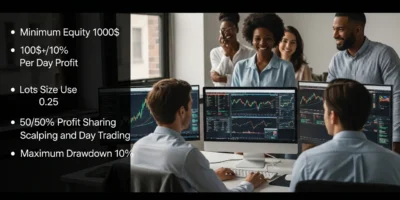
- Maximum Drawdown (MDD): The peak-to-trough decline in an account’s equity curve over a specific historical period. A low maximum drawdown (e.g., under 10%) combined with consistent gains is the hallmark of a structurally defensive management strategy.
- Sharpe Ratio: A measure that calculates the excess return earned per unit of volatility in an asset or trading strategy. A higher Sharpe ratio indicates superior risk-adjusted efficiency.
- Sortino Ratio: Similar to the Sharpe ratio, but it only factors in downside or negative volatility. This metric provides a more accurate reflection of the risk associated with unexpected capital losses.
4. Professional Risk Management Frameworks
To maintain structural stability and protect capital, top-tier managed forex accounts implement rigorous risk controls directly into their execution infrastructure. These mechanisms serve as defenses against catastrophic market anomalies.
Strict Position Sizing and Capital Allocation
A primary differentiator between speculative retail trading and professional money management is position sizing. Conservative managed accounts rarely risk more than 1% to 2% of the total portfolio value on any single currency pair transaction. By keeping position sizes small relative to total equity, the portfolio can withstand an extended series of consecutive losses without triggering margin calls or destabilizing drawdowns.
Hard Stop-Loss Orders and Take-Profit Levels
Every trade executed by an institutional manager is anchored by defined exit criteria. Hard stop-loss orders are embedded into the broker’s server architecture to ensure that if a currency pair moves against a position, the trade is automatically liquidated at a predetermined price threshold. This protects the account from unexpected, high-velocity market movements caused by unscheduled geopolitical events or macroeconomic reports.
Cross-Currency Diversification and Correlation Management
Amateur trading often suffers from over-concentration in a single currency pair, such as the EUR/USD. Professional managers mitigate this by diversifying across uncorrelated asset pairs. By balancing positions across major pairs, minor pairs, and commodity currencies (like the AUD or CAD), the system reduces structural vulnerability to any single regional economic shock.
5. Due Diligence: Mitigating Operational Risks and Frauds
The regulatory decentralization of the global forex market creates operational risks that demand extensive due diligence from investors. Because capital remains under the legal title of the investor within their brokerage account, verifying the legitimacy of both the broker and the account manager is essential.
Regulatory Verification
Legitimate managed accounts operate under the strict oversight of Tier-1 financial regulatory jurisdictions. Before committing capital, investors should verify that the money manager and the partner brokerage hold active licenses with reputable regulatory bodies, such as:
- FCA (Financial Conduct Authority) – United Kingdom
- ASIC (Australian Securities and Investments Commission) – Australia
- NFA / CFTC (National Futures Association / Commodity Futures Trading Commission) – United States
- CySEC (Cyprus Securities and Exchange Commission) – Europe
Regulatory compliance ensures that the broker adheres to strict capitalization requirements, maintains segregated client bank accounts, and undergoes regular operational audits.
Performance Verification via Third-Party Portals
Investors should never rely solely on equity curves or spreadsheets published directly by the manager. Credible investment managers subject their historical trading data to independent verification platforms such as Myfxbook or FX Blue. These platforms link directly to the broker’s terminal read-only API, generating audited, tamper-proof performance statistics that confirm historical returns, drawdown metrics, and trading consistency.
┌────────────────────────┐       API Read-Only Link       ┌────────────────────────┐
│     Forex Broker       │ ─────────────────────────────► │ Third-Party Verifier   │
│ (Live Trading Server)  │                                │ (e.g., Myfxbook)       │
└────────────────────────┘                                └────────────────────────┘
                                                                      │
                                                                      ▼
                                                          Audited, Tamper-Proof
                                                          Performance Analytics
6. Fee Structures and Incentives
Managed forex accounts generally operate on an institutional performance fee model, aligning the financial interests of the money manager directly with the net profitability of the investor.
The High-Water Mark Principle
The standard fee architecture revolves around a performance fee (often ranging from 20% to 30% of net new profits) combined with a High-Water Mark (HWM) clause. The High-Water Mark ensures that the manager only collects a fee when the account’s equity exceeds its previous highest value.
Example: If an investor deposits $100,000 and the manager grows the account to $110,000, a performance fee is calculated on the $10,000 gain. If the account subsequently experiences a drawdown back to $105,000, the manager cannot collect any further performance fees until the account equity recovers and breaches the $110,000 threshold.
This mechanism protects investors from paying fees for choppy or inconsistent performance.

Contact Us | |
Telegram | |
Mail Us | |
Want to Join All Indicators VIP Access | |
Account Management More Details |
Conclusion: Balancing Automation and Awareness
Managed forex accounts offer a viable pathway for individuals seeking exposure to the foreign exchange market under the guidance of professional management. While the phrase “low-risk, high-return” is an idealized financial target, true risk mitigation is achieved through rigorous position sizing, hard stop-loss enforcement, and transparent account architecture like PAMM or MAM systems.
By prioritizing regulatory compliance, insisting on third-party verified track records, and ensuring the presence of high-water mark protections, investors can safely navigate the currency markets while minimizing operational and systemic risks.