Blog
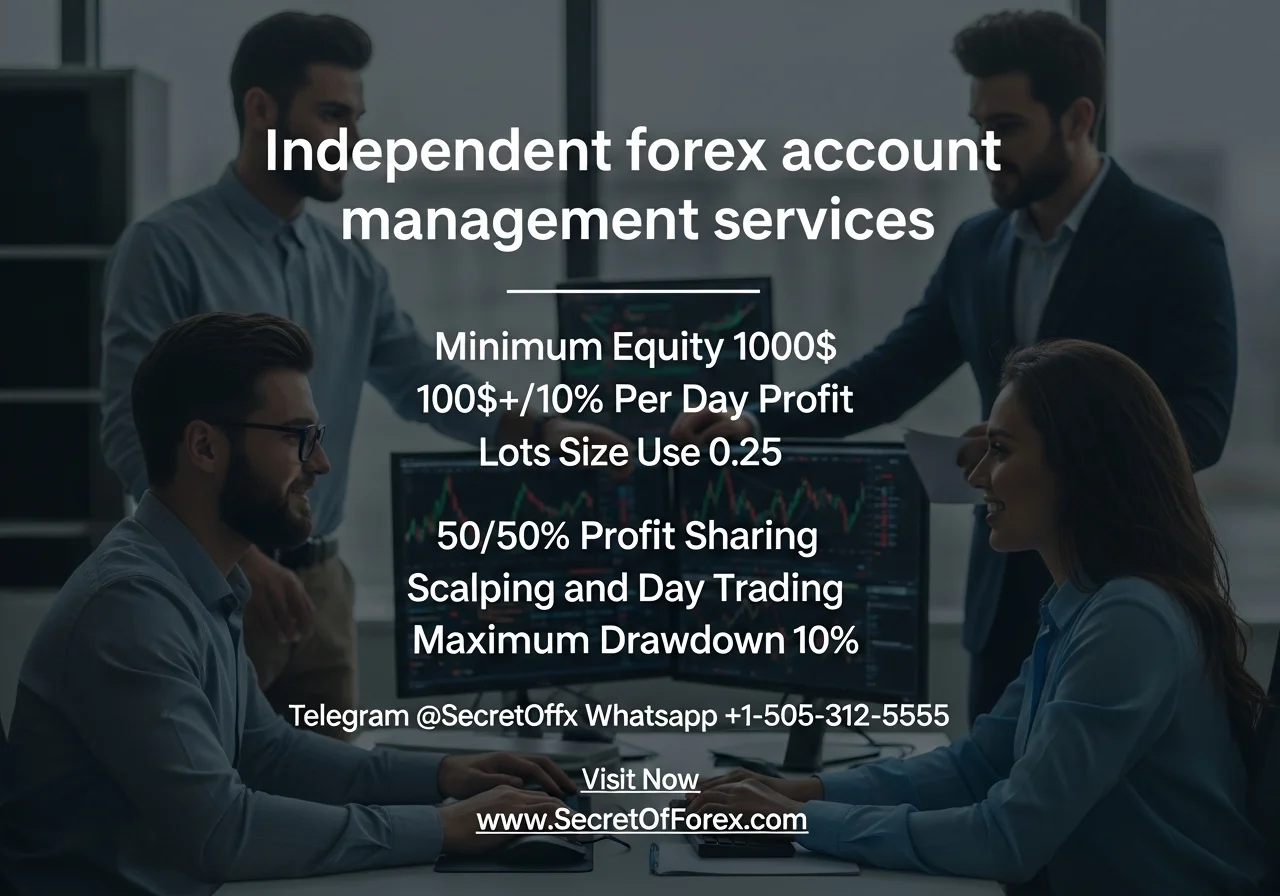
Independent Forex Account Management Services

The Foreign Exchange (Forex) market operates 24 hours a day, five days a week, trading over $7 trillion daily. For individual investors, the sheer scale, liquidity, and volatility of this market present a unique dilemma: the potential for high returns is substantial, but the learning curve is steep, and the risk of capital loss is high.
This reality has driven the growth of Independent Forex Account Management Services. These services allow investors to participate in the currency markets without needing to trade themselves. Instead, professional, independent traders or boutique asset management firms manage the capital on the client’s behalf.
This comprehensive guide explores how independent Forex account management works, the structures that govern it, its core benefits and risks, and how to evaluate a provider to protect and grow your capital.
Contact Us | |
Telegram | |
Mail Us | |
Want to Join All Indicators VIP Access | |
Account Management More Details |

Understanding Independent Forex Account Management
At its core, an independent Forex account management service involves a retail investor allocating capital to a managed account, where an experienced trader or money manager executes trades on their behalf.
Unlike traditional mutual funds or large institutional wealth management setups, independent services are typically run by specialized boutique firms, proprietary trading groups, or licensed individual professional traders. They are “independent” because they are not directly tied to a single major banking institution, giving them the flexibility to utilize diverse trading strategies, unique risk management parameters, and personalized client relationships.
The Standard Operational Model: PAMM and MAM Accounts
The modern Forex industry relies on specific technology architectures to ensure security, transparency, and seamless execution. Managed accounts are rarely handled by passing around passwords or manually copying trades into dozens of individual accounts. Instead, they utilize two primary structures:
- PAMM (Percent Allocation Management Module): In a PAMM setup, the manager operates a single “master account.” When investors deposit funds, their capital is pooled virtually into this master account. When the manager executes a trade, profits or losses are distributed automatically back to the investors’ individual accounts based on the percentage of capital they contributed to the overall pool.
- MAM (Multi-Account Manager): A MAM account is an evolution of the PAMM system. It offers the money manager more flexibility in allocating trades. Instead of strictly distributing based on a percentage of capital, the manager can customize leverage, risk profiles, and trade sizes for individual accounts within the pool. This is highly beneficial if different clients have varying risk tolerances.
The Security Profile: Power of Attorney (LPOA)
A common misconception is that a Forex account manager can withdraw a client’s money and disappear. In a legitimate setup, this is structurally impossible.
The relationship is governed by a Limited Power of Attorney (LPOA) agreement signed by the client, the manager, and the broker.
Crucial Distinction: The LPOA grants the manager the right to execute trades using the client’s funds, but explicitly denies them the right to withdraw or transfer funds out of the account. Only the account owner (the investor) retains withdrawal rights.
Key Benefits of Managed Forex Accounts
For investors looking to diversify their portfolios beyond traditional equities, bonds, and real estate, independent Forex management offers several distinct advantages.
1. Hands-Free Access to Global Currency Markets
The most obvious benefit is leveraging professional expertise. Successful Forex trading requires years of screen time, a deep understanding of macroeconomic indicators, technical analysis, and psychological discipline. A managed service allows individuals to benefit from this skill set without spending hours analyzing charts or monitoring geopolitical news.
2. Potential for Non-Correlated Returns
Traditional financial portfolios are highly vulnerable to stock market downturns. The Forex market, however, behaves differently. Because currencies are always traded in pairs (e.g., EUR/USD), a trader can profit just as easily when a currency is falling as when it is rising by taking a short position. This makes Forex an excellent tool for diversification, offering returns that are often entirely uncorrelated with the broader equities or real estate markets.
3. Complete Liquidity and Control
Unlike hedge funds or private equity placements that require “lock-up periods” (where your money is tied up for months or years), retail managed Forex accounts generally offer high liquidity. Because the funds remain in the investor’s individual brokerage account, the investor can revoke the LPOA and withdraw their remaining capital at almost any time, subject to processing times and open trade considerations.
4. Alignment of Interests through Performance Fees
Most independent managers operate on a “No Profit, No Fee” structure, driven by a High-Water Mark rule. This means the manager only earns money when they make money for the client.
Fee Structures Explained
To properly evaluate a service, an investor must understand how independent managers are compensated. The standard model consists of two primary layers:
The Management Fee (AUM Fee)
Some managers charge an annual fee based on total Assets Under Management (AUM), typically ranging from 1% to 2%, billed monthly or quarterly. This covers operational costs, data feeds, and basic administrative expenses. However, many boutique independent managers waive this fee entirely to make their services more attractive, relying purely on performance.
The Performance Fee and the High-Water Mark
The performance fee is the primary incentive for a money manager, usually ranging from 20% to 35% of net profits generated.
To protect the investor, this fee must be governed by a High-Water Mark (HWM) clause. The HWM ensures that a manager does not get paid a performance fee for simply recovering losses.
Example of the High-Water Mark in Action:
- An investor deposits $100,000.
- In Month 1, the manager grows the account to $110,000 (+$10,000 profit). The manager takes their 20% performance fee ($2,000). The new High-Water Mark is set at $110,000.
- In Month 2, a market downturn hits, and the account drops to $102,000. No fee is charged.
- In Month 3, the manager recovers the account to $108,000. Even though the account grew by $6,000 that month, no performance fee is charged because the total account value is still below the peak High-Water Mark of $110,000.
- In Month 4, the account reaches $115,000. The manager is now eligible to collect a 20% fee, but only on the $5,000 profit that exceeded the previous peak of $110,000.
Evaluating the Risks
While the upside of professional currency management is compelling, Forex trading carries substantial, inherent risks. A transparent provider will always emphasize these risks rather than hiding them behind marketing fluff.
Market Volatility and Leverage
Forex is traded on margin, meaning managers use leverage to amplify small fluctuations in currency prices into significant gains. However, leverage is a double-edged sword. If a manager misjudges a macroeconomic shift or an unexpected geopolitical event occurs (such as an unscheduled central bank rate decision), leverage can dramatically accelerate losses.
Drawdown Risks
Every trading strategy experience drawdowns—periods where the account value drops from its peak before recovering. Investors must understand a manager’s historical Maximum Drawdown (Max DD). If an investor panicked and withdrew capital during a standard strategy drawdown, they would lock in those losses permanently.
Operational and Regulatory Discrepancies
The Forex market is decentralized, leading to differing regulatory environments worldwide. Rogue managers can operate from unregulated offshore jurisdictions, colluding with B-book brokers to manipulate trading results or siphon off money through hidden, excessive commissions (known as “churning”).
How to Conduct Due Diligence on a Service Provider
Before allocating a single dollar to an independent Forex account management service, a rigorous vetting process is required.
                       DUE DILIGENCE CHECKLIST
                                  │
         ┌────────────────────────┼────────────────────────┐
         ▼                        ▼                        ▼
┌─────────────────┐      ┌─────────────────┐      ┌─────────────────┐
│  Track Record   │      │ Broker Quality  │      │ Risk Parameters │
│  Verification   │      │  & Regulation   │      │   & Strategy    │
└─────────────────┘      └─────────────────┘      └─────────────────┘
1. Demand Verified Track Records
Never accept screenshots, Excel spreadsheets, or PDF reports as proof of performance. A legitimate manager will provide access to an independent, third-party auditing platform like Myfxbook or FX Blue, or present a GIPS-compliant (Global Investment Performance Standards) historical track record. These platforms link directly to the broker’s server via a read-only investor password, verifying every trade, fee, and drawdown calculation.
2. Verify Broker Quality and Regulation
The manager should only operate through reputable, Tier-1 regulated brokerages (e.g., firms overseen by the FCA in the UK, ASIC in Australia, or NFA/CFTC in the United States). The broker should keep client funds in segregated bank accounts at top-tier international banking institutions, ensuring that even if the broker or the manager goes bankrupt, the client’s principal remains safe.
3. Analyze the Trading Methodology and Risk Management
An investor should clearly understand how the manager generates returns.
- Does the strategy rely on manual discretionary trading, or is it algorithmic?
- Does it use high-risk methodologies like Martingale (doubling down on losing trades) or Grid trading (stacking trades without stop-losses)? These strategies can show smooth profit curves for months before suddenly wiping out an entire account.
- What are the hard equity-stop parameters? If a manager promises a 10% monthly return but has a historical maximum drawdown of 60%, the risk profile is fundamentally asymmetric and dangerous for conservative capital.
Red Flags to Watch Out For
To stay safe in the alternative investment landscape, be highly alert to the following warning signs:
| Red Flag | Explanation |
| Guaranteed Returns | No one can guarantee returns in a volatile, decentralized market. Any promise of fixed daily, weekly, or monthly gains is a hallmark sign of a Ponzi scheme. |
| Mandatory Offshore Brokers | If a manager insists that you use a specific, un-regulated broker registered in an obscure offshore tax haven, avoid them. They may be receiving massive commission rebates by burning through your capital. |
| Lack of Transparency | If a provider refuses to show real-time equity drawdowns or hides past losing accounts, they are intentionally keeping you in the dark. |
Contact Us | |
Telegram | |
Mail Us | |
Want to Join All Indicators VIP Access | |
Account Management More Details |
Conclusion
Independent Forex account management services offer a viable, sophisticated gateway for investors looking to diversify away from traditional equity markets and tap into global currency movements. By utilizing secure technology structures like PAMM/MAM setups and LPOA agreements, investors can retain legal control over their funds while delegating the daily execution to experienced market specialists.
However, success in this space depends entirely on the depth of your initial due diligence. By treating these services not as a shortcut to overnight wealth, but as a long-term, calculated alternative asset allocation—built on verified track records, institutional-grade brokers, and strict risk controls—investors can effectively mitigate downside exposure while capturing the unique, uncorrelated returns that only the Forex market can provide.